Launch offer — valid today only

📄 Digital book in PDF · read it on your phone or print it

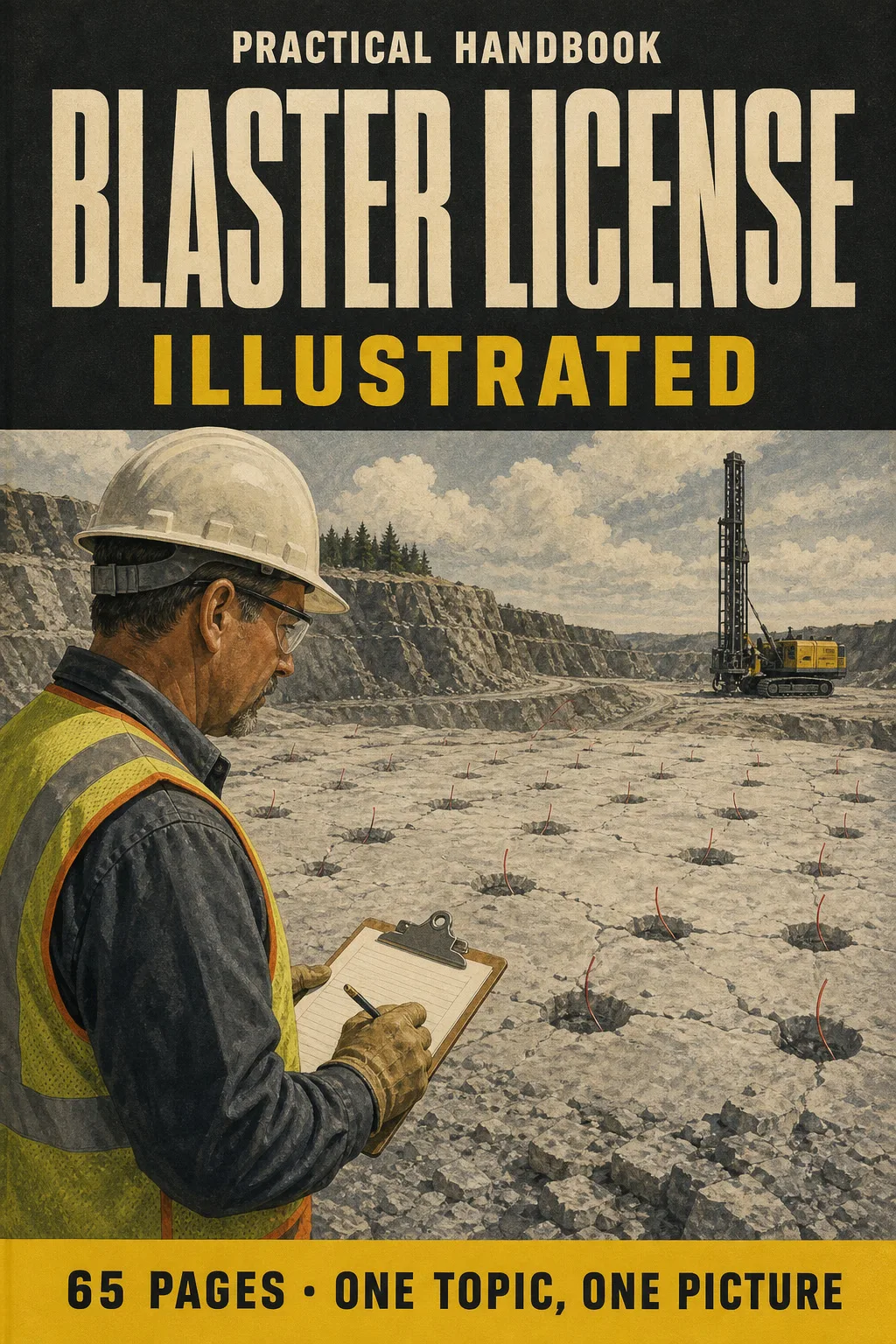
The Blaster's License Exam in Drawings: Read the Bench, Work the Formulas, Know the Storage Rules One Topic on Every Page

Burden and stemming, shock tube hookups, powder factor, scaled distance, PPV, misfires, ATF magazines and blast records. Every topic gets its own page: the drawing first, then what you need to remember. 65 illustrated pages.

START STUDYING THIS WAY

🔒 Secure checkout · PDF by email · 30-day guarantee

Every topic, its own pageEvery rule and calculation drawn, with the explanation right beside it
65 illustrated pages8 parts, from who regulates what to your last week before the exam
Up-to-date sourcesFederal rules: 27 CFR 555 (ATF), 30 CFR 816/817 (OSMRE), MSHA, OSHA and DOT · State example: 25 Pa. Code Ch. 211
PDF by emailFormat

Look Inside the Book

Every page has one big drawing and a box with the numbers and rules you need to know:

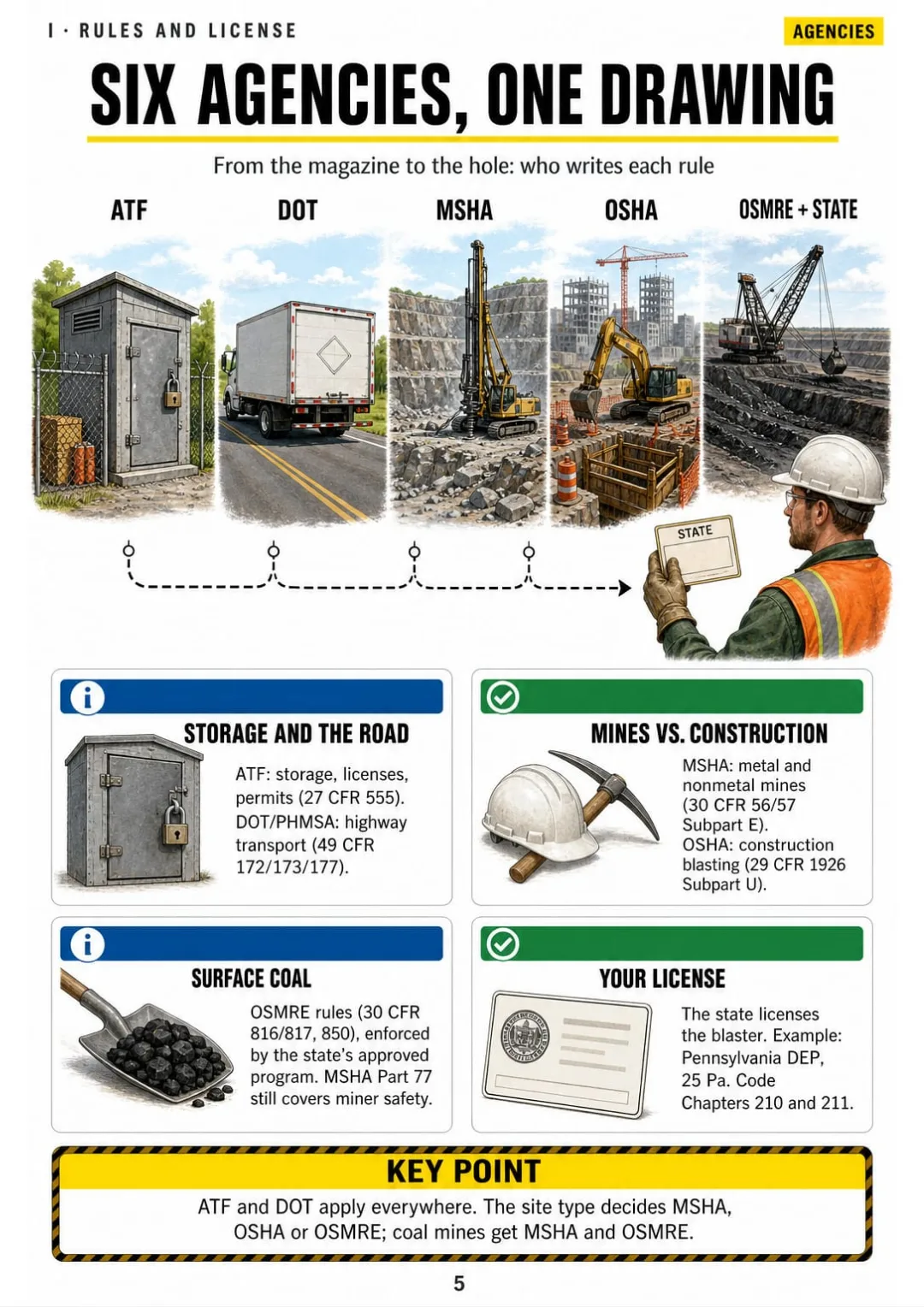
ATF stores, DOT hauls, MSHA mines, OSHA builds, OSMRE coal, the state licenses you.
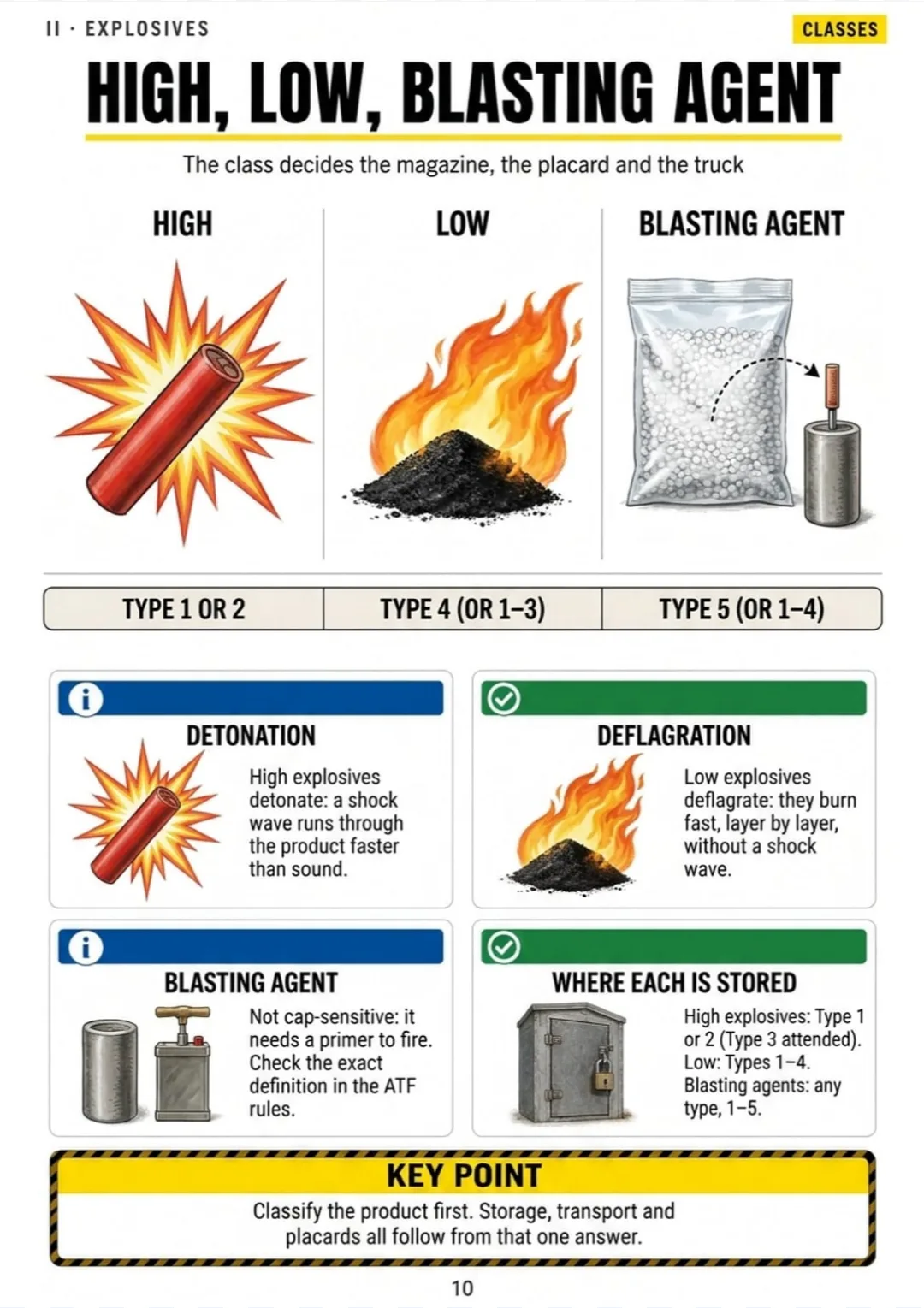
High explosive detonates, low explosive burns, blasting agent detonates only from a primer, never a bare cap.
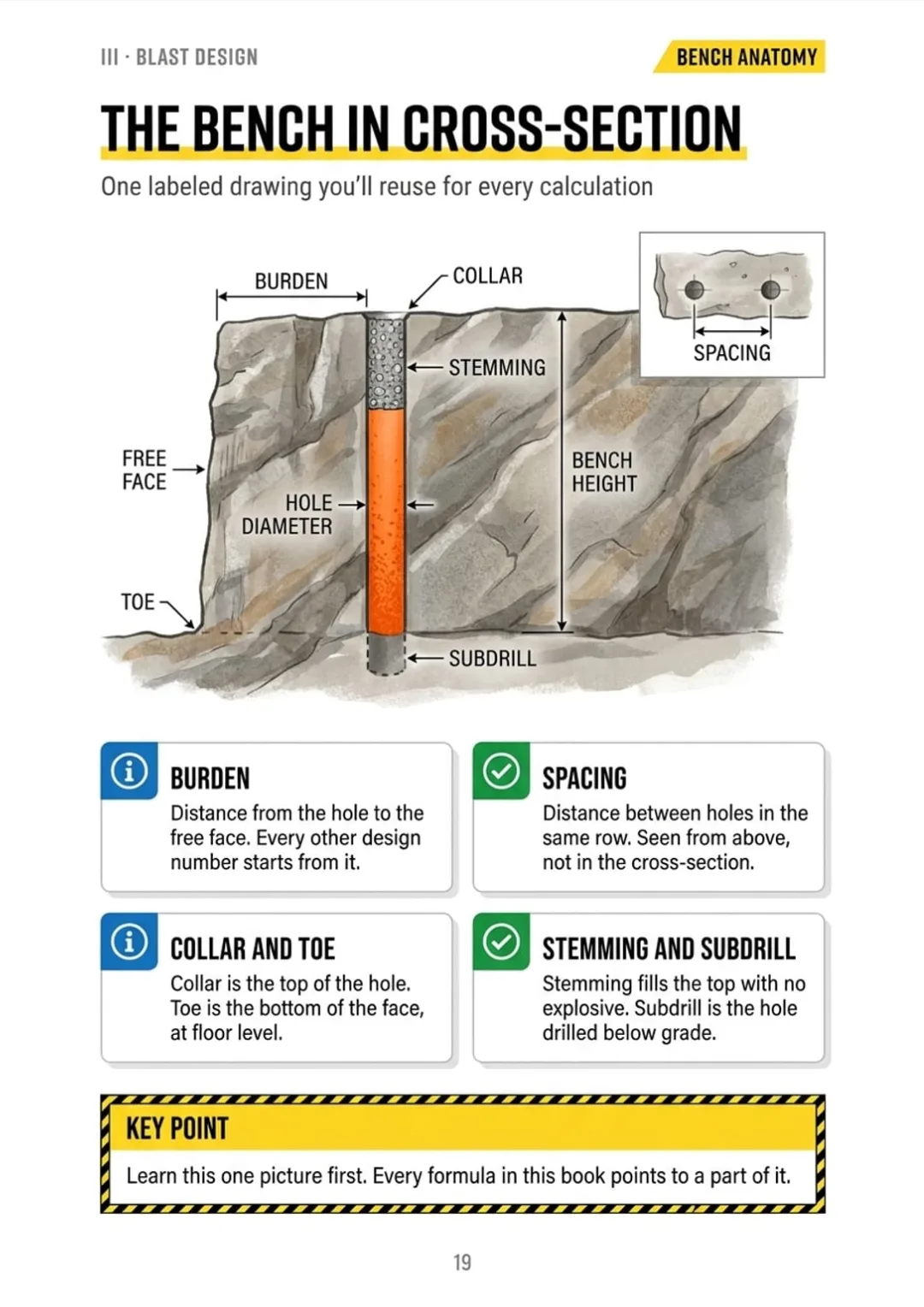
Bench height, hole diameter, burden, spacing, stemming, subdrill, collar, toe and free face on one drawing
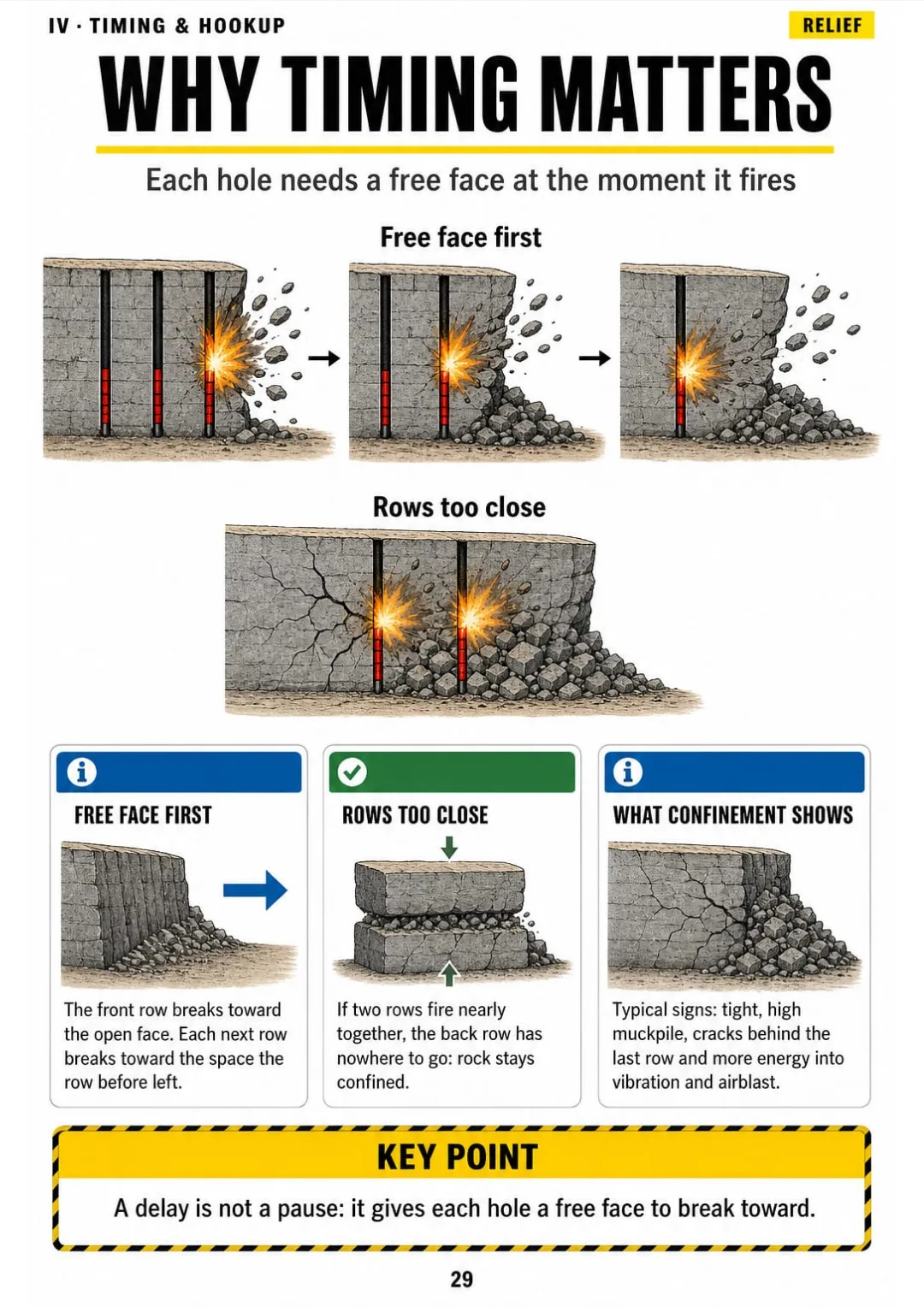
Row by row: each hole breaks toward the space the previous row opened.
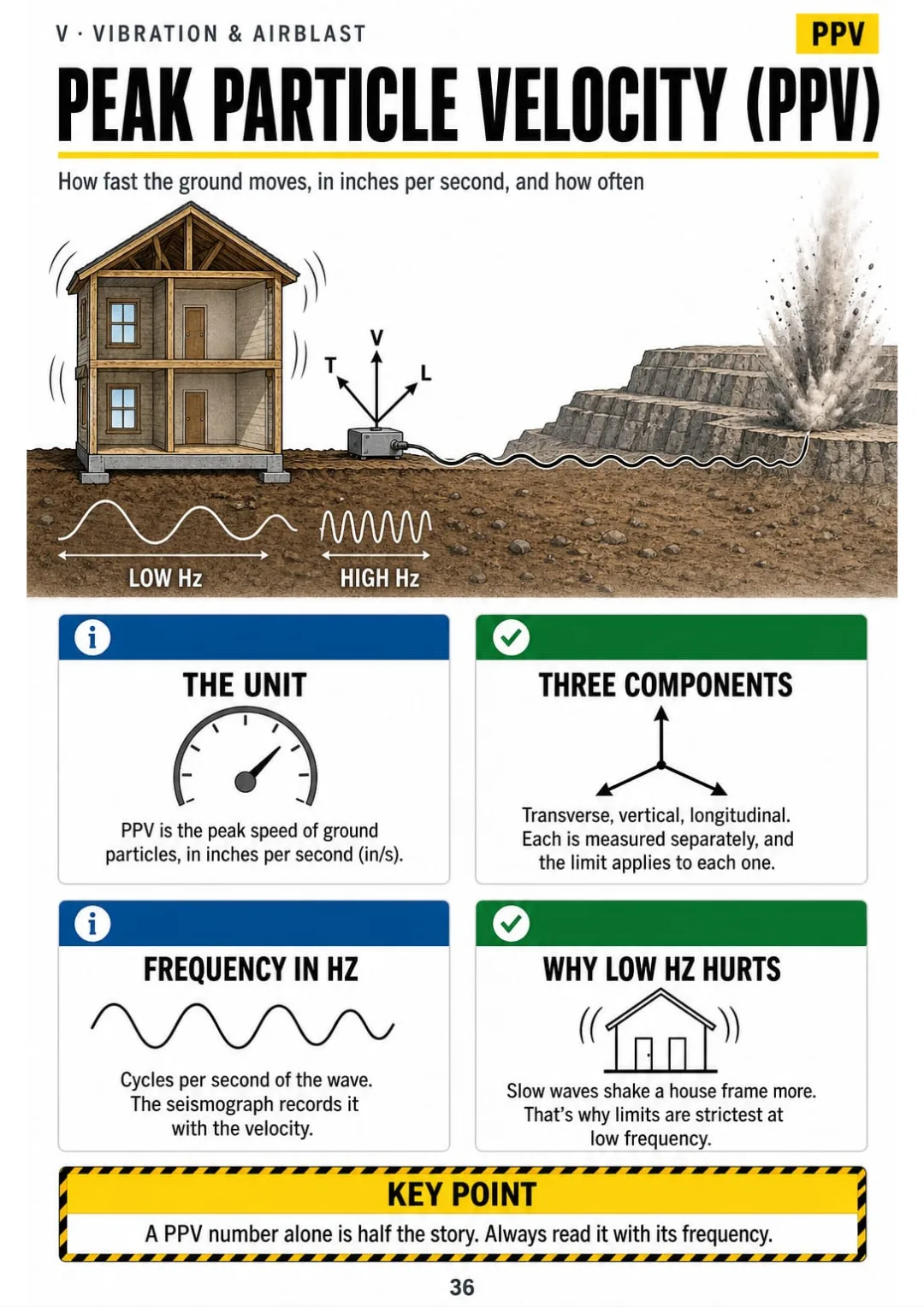
PPV in in/s on three components, plus frequency in Hz: low frequency is the bigger risk
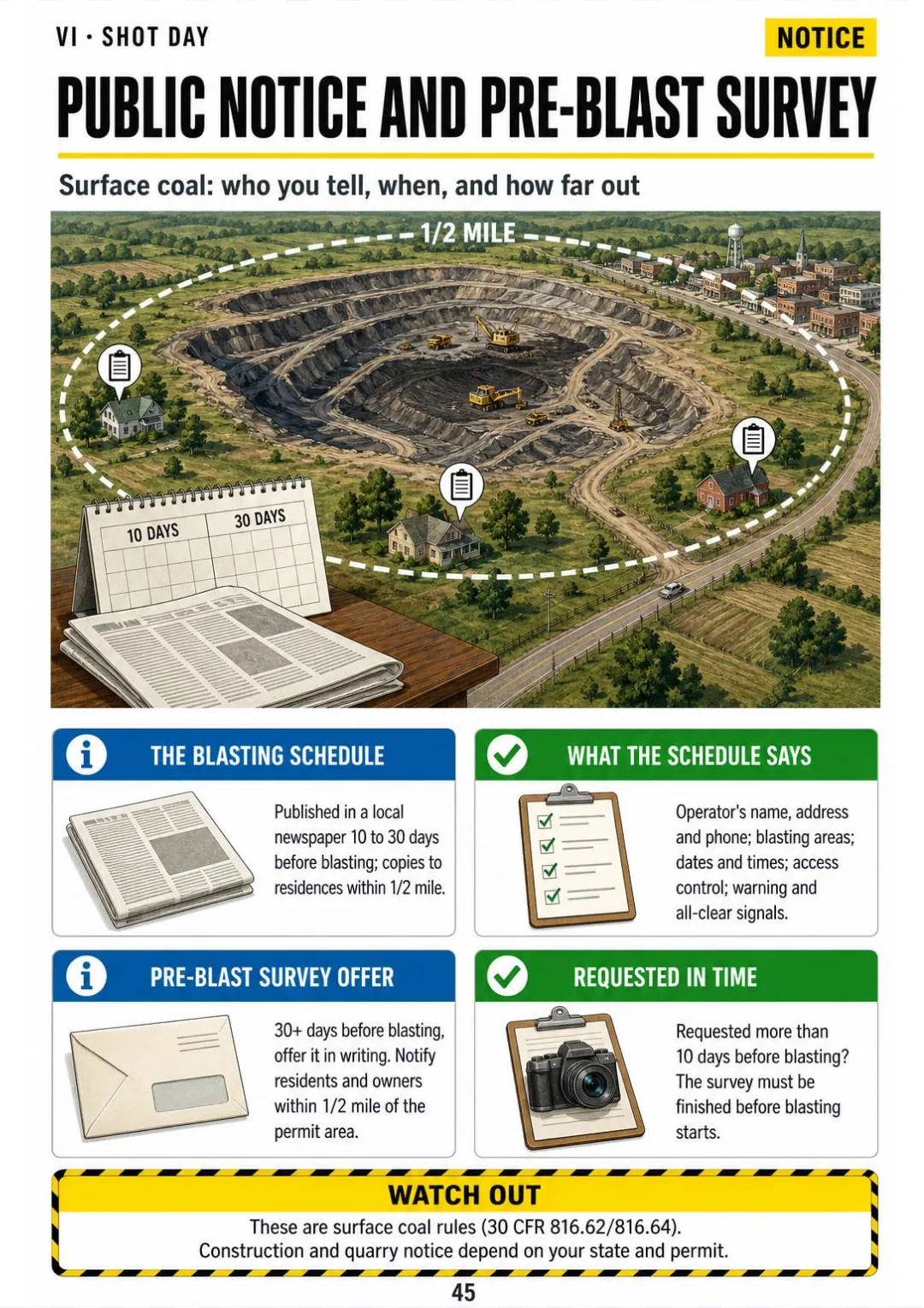
Schedule published 10–30 days before; pre-blast survey offered within 1/2 mile (30 CFR 816.62/816.64)
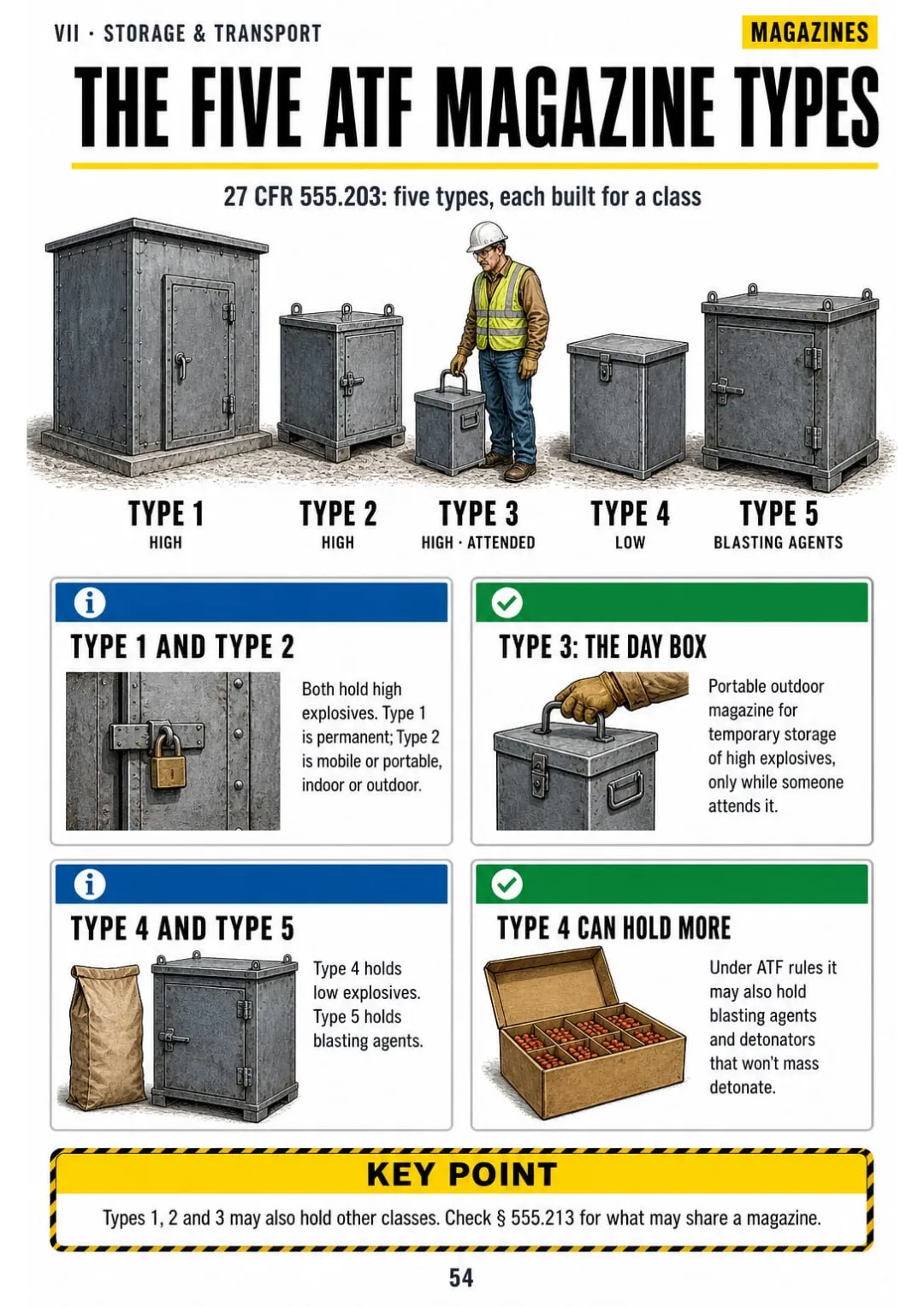
Type 1–2 high explosives · Type 3 day box, attended · Type 4 low · Type 5 blasting agents
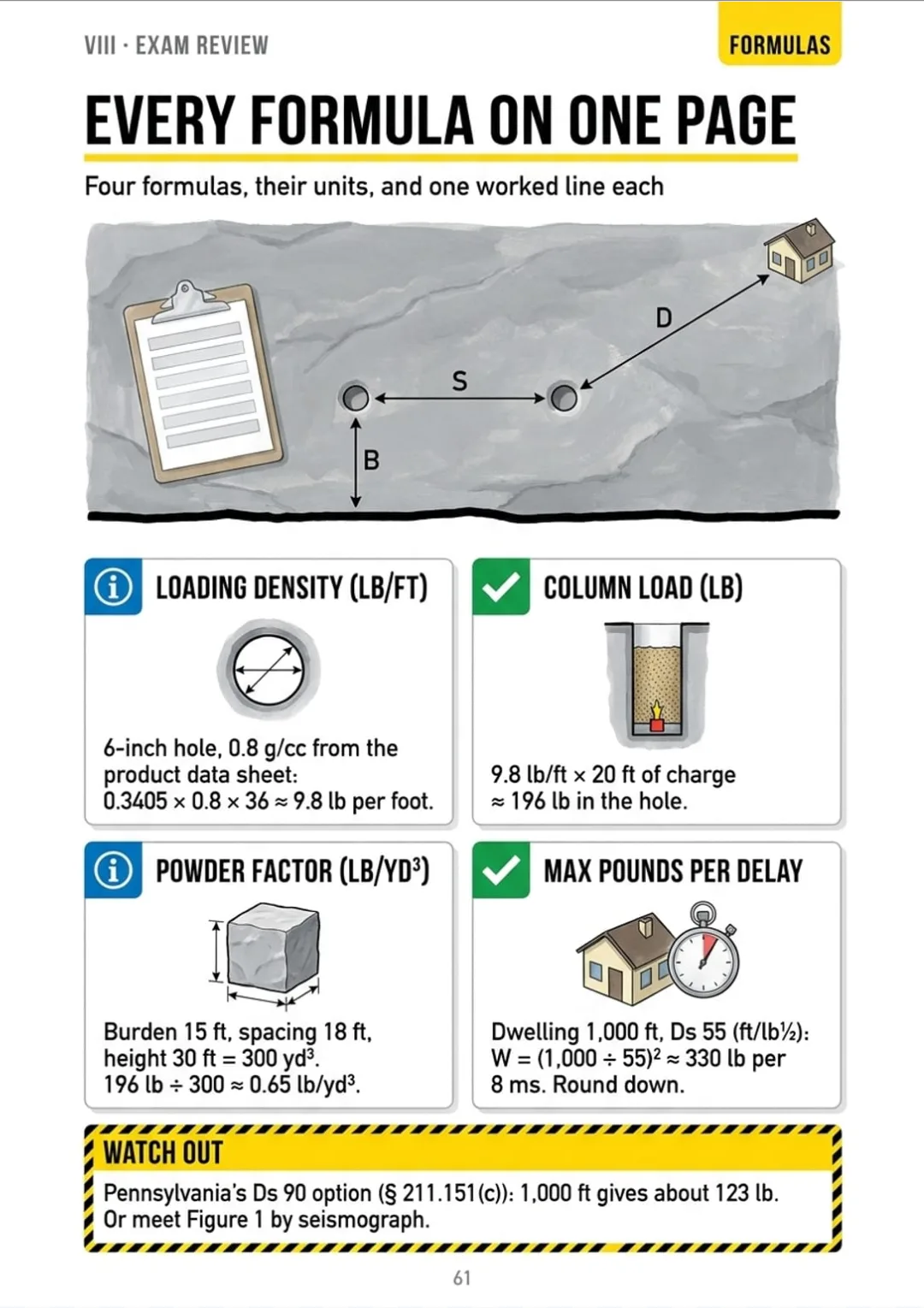
W = (D ÷ Ds)²: 1,000 ft at Ds 55 ≈ 330 lb per 8 ms delay

Swipe to see more →

These are real pages from the book. The table of contents is the full one: 8 parts and 61 topics.

The Problem Isn't You. It's How It Was Explained.

You're at the exam table. The question: a hole didn't fire. How long do you wait, and who walks up to it? You've seen misfires on the bench. You've never had to answer one in rule language.

The rulebook gives it to you in paragraphs: wait times by initiation system, who may approach, what goes in the blast record. One citation after another and not one picture, so by morning they blur together.

Bench height, hole diameter, burden, spacing, stemming, subdrill, collar, toe and free face on one drawing

In the book, the misfire is one page: the steps in order, the wait by initiation system, who goes in and what you write in the record, all on the same drawing.

The delay plan, scaled distance, misfire steps and the five ATF magazine types work the same way. Each one gets its own page.

You see where each number sits on the bench, and you answer the question without going back to the manual.

COMPARE FOR YOURSELF

The Same Topic, Two Ways to Study It

THIS
  • The manual: line after line
  • Scaled distance explained only in words
  • You walk into the exam unsure
The maximum weight of explosives to be detonated within any 8-millisecond period may be determined by the formula W = (D/Ds)², where W is the maximum weight of explosives, in pounds, that can be detonated in any 8-millisecond period; D is the distance, in feet, from the blasting site to the nearest protected structure; and Ds is the scaled-distance factor, which may initially be approved by the regulatory authority using the values for scaled-distance factor listed in the table for the distance from the blasting site.
FOR THIS
  • Scaled distance in one drawing, with a worked example in US units
  • The key rules in one box
  • You see it and it makes sense
High explosive detonates, low explosive burns, blasting agent detonates only from a primer, never a bare cap.
CONTENTS

Take a Look at the 8 Parts and 61 Topics

The rules and the license, explosives and initiation, blast design, timing and hookup, vibration and airblast, shot day, storage and transport, and exam review: 65 pages, all illustrated.

IThe Rules and the License · pp. 5-9
  1. Who Regulates What: One Drawing, Six Agencies
  2. Your State Blaster's License and What the Exam Covers
  3. How to Read a Rule Citation
  4. The Words the Exam Uses
  5. The Blaster-in-Charge: What Lands on Your Signature
IIExplosives and Initiation · pp. 10-18
  1. High Explosive, Low Explosive, Blasting Agent
  2. ANFO: 94/6 and Why the Smoke Color Matters
  3. Emulsions, Water Gels and Heavy ANFO
  4. Boosters and Primers
  5. Detonating Cord: Grains per Foot
  6. Shock Tube Systems
  7. Electric Detonators and the Circuit Check
  8. Electronic Detonators
  9. Safety Fuse and Cap
IIIBlast Design: The Bench Drawn · pp. 19-28
  1. The Bench in Cross-Section
  2. Burden: The Number Everything Starts From
  3. Spacing and Pattern
  4. Stemming: Length and Material
  5. Subdrilling and the Toe
  6. Stiffness Ratio: Bench Height ÷ Burden
  7. Loading Density: Pounds per Foot of Hole
  8. Powder Factor, Worked Once in US Units
  9. The Front Row and the Face Profile
  10. Geology: Where Flyrock Starts
IVTiming and Hookup · pp. 29-35
  1. Why Timing Matters
  2. Hole-to-Hole and Row-to-Row Delays
  3. The Delay Plan Drawn Hole by Hole
  4. The 8-Millisecond Rule
  5. Downhole vs. Surface Delays
  6. Decking: Two Charges in One Hole
  7. Checking the Hookup Before You Fire
VVibration, Airblast and Flyrock · pp. 36-44
  1. Peak Particle Velocity (PPV)
  2. Scaled Distance: Ds = D ÷ √W
  3. The OSMRE Distance Table
  4. Worked Example: Maximum Pounds per Delay
  5. Frequency-Based Limits: The Z-Curve
  6. Airblast Limits
  7. What Makes Airblast Worse
  8. Flyrock: The Limit and the Control
  9. Setting Up the Seismograph
VIShot Day: Loading, Firing, Misfires, Records · pp. 45-53
  1. Public Notice and the Pre-Blast Survey
  2. Loading at the Hole
  3. Lightning and Extraneous Electricity
  4. Blast Area Security and Guarding
  5. Warning and All-Clear Signals
  6. The Post-Blast Examination
  7. Misfires: The Steps in the Same Order Every Time
  8. Misfires: What You Never Do
  9. The Blast Record Field by Field
VIIStorage and Transport · pp. 54-60
  1. The Five ATF Magazine Types
  2. What Can Share a Magazine and What Can't
  3. Reading the Table of Distances
  4. The Magazine Site
  5. Inspections, Daily Summary, Theft
  6. Transport: Classes and Placards
  7. Stock Rotation and Damaged Product
VIIIExam Review · pp. 61-65
  1. Every Formula on One Page
  2. Every Number on One Page
  3. Shot-Day Checklist
  4. The Most Frequent Mistakes in Exam Questions
  5. Your Last Week Before the Exam

One Page, One Topic, All Clear

Think of it this way:

You're planning a shot 1,000 feet from the nearest house. You need the maximum pounds per delay, and you need the right number.

You open the scaled distance page and it's drawn: the distance, the square root of the charge and W = (D ÷ Ds)², worked out in US units, with the answer boxed at the bottom.

PPV in in/s on three components, plus frequency in Hz: low frequency is the bigger risk

The bench in cross-section, the delay plan hole by hole, the misfire steps and the five ATF magazine types work the same way. Each one has its own page.

Blaster License Illustrated has 8 parts and 61 topics, all drawn. It ends with every formula and every number on one page, a shot-day checklist and a plan for your last week before the exam.

What you see drawn, you don't have to memorize.

What's Inside Blaster License Illustrated:

Ipp. 5-9

The Rules and the License

Who regulates what, your state license and what the exam covers, how to read a rule citation, the exam's vocabulary and what the blaster-in-charge signs off on.

IIpp. 10-18

Explosives and Initiation

High explosives, low explosives and blasting agents, ANFO and smoke color, emulsions and heavy ANFO, boosters, det cord, shock tube, electric and electronic detonators, and safety fuse.

IIIpp. 19-28

Blast Design: The Bench Drawn

The bench in cross-section, burden, spacing, stemming, subdrilling, stiffness ratio, loading density, powder factor in US units, the front row and where flyrock starts.

IVpp. 29-35

Timing and Hookup

Why timing matters, hole-to-hole and row-to-row delays, the delay plan drawn hole by hole, the 8-millisecond rule, downhole vs. surface delays, decking and the hookup check.

Vpp. 36-44

Vibration, Airblast and Flyrock

Work out the maximum pounds per delay for any distance: PPV, scaled distance, the OSMRE distance table, the Z-curve, airblast limits, flyrock control and seismograph setup, each one drawn.

VIpp. 45-53

Shot Day: Loading, Firing, Misfires, Records

Public notice and the pre-blast survey, loading, lightning, blast area security, warning signals, the post-blast exam, misfire steps and the blast record field by field.

VIIpp. 54-60

Storage and Transport

The five ATF magazine types, what can share a magazine, the table of distances, the magazine site, inspections and theft, transport placards and stock rotation.

VIIIpp. 61-65

Exam Review

Every formula and every number on one page, a shot-day checklist, the most frequent mistakes in exam questions and your last week before the exam.

At the end of the book: Every formula and every number on one page, a shot-day checklist and the most frequent mistakes in exam questions.
Plus: 2 Free Books

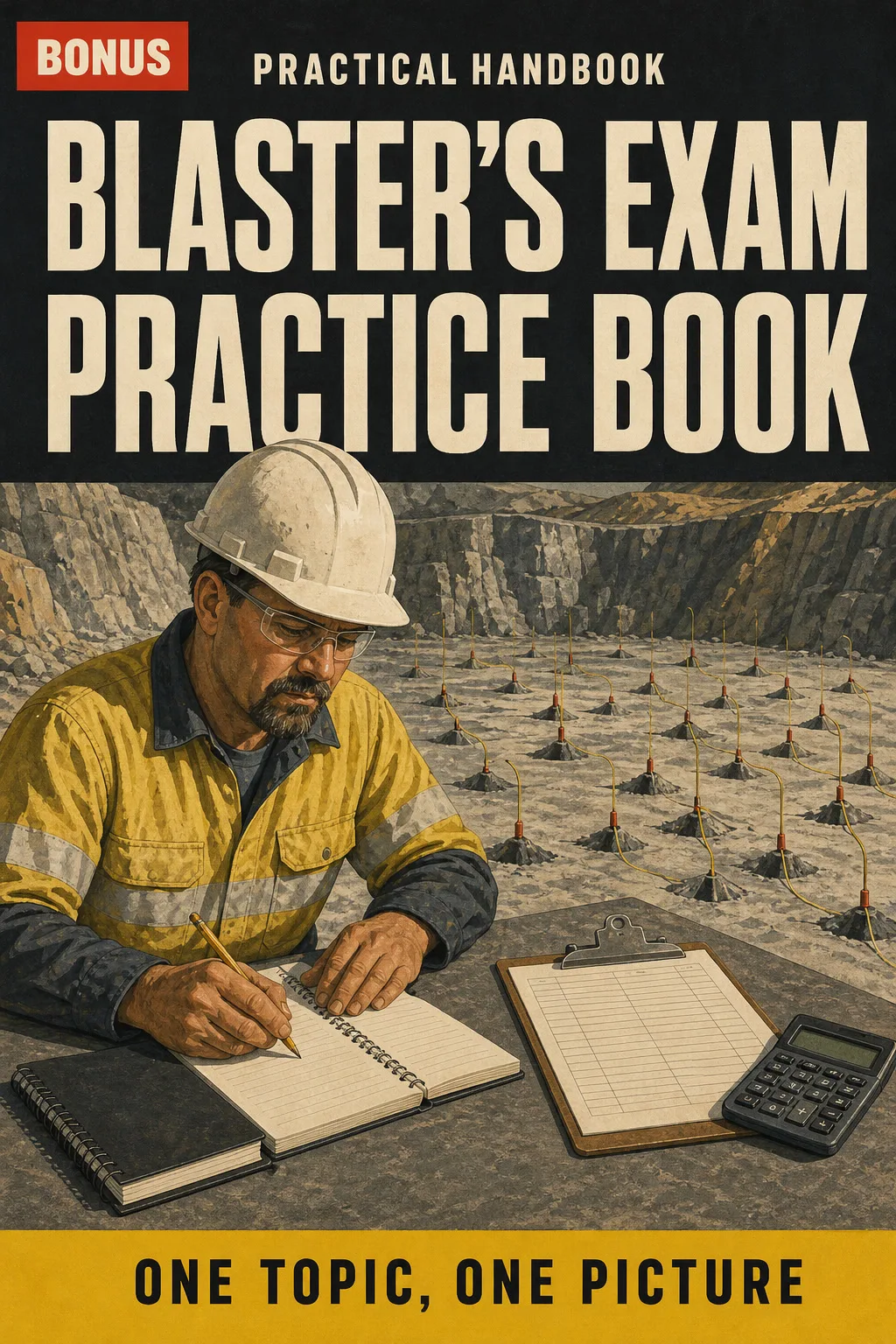
Blaster's Exam Practice Book

BONUS 1: «Blaster's Exam Practice Book»

Value on its own: US$ 17.90

Exam-style questions on every chapter, each with the answer explained, so you find your weak spots before exam day, not on it.

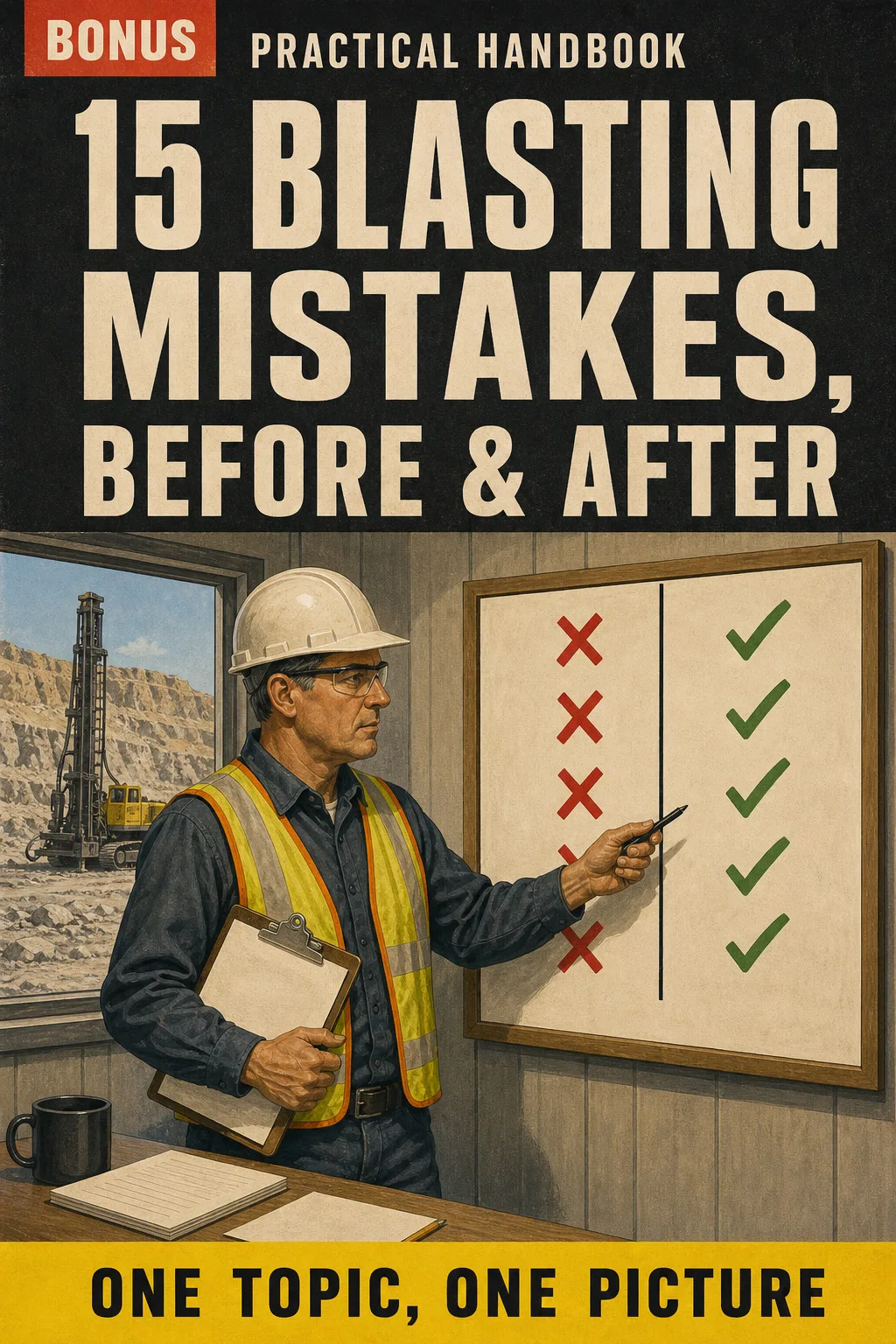
15 Blasting Mistakes, Before & After

BONUS 2: «15 Blasting Mistakes, Before & After»

Value on its own: US$ 14.90

The most common loading, hookup and misfire mistakes drawn side by side with the right way, for a quick review the night before.

Blaster License Illustrated with 2 Free Books

  • Blaster License Illustrated: 65 illustrated pagesUS$ 63
  • BONUS 1: Blaster's Exam Practice BookUS$ 17.90
  • BONUS 2: 15 Blasting Mistakes, Before & AfterUS$ 14.90
  • High-resolution PDF to printIncluded
Total value US$ 95.80
YOUR PRICE:
US$ 27
You save US$ 68.80
YES, I WANT BLASTER LICENSE ILLUSTRATED FOR US$ 27

📄 This is a digital PDF book sent to your email: nothing is printed or shipped.

Secure purchaseEncrypted payment30-day guarantee

PDF by email: We email you Blaster License Illustrated as a PDF, together with the two free books. It's a single payment: no installments, no extra charges.

Who This Book Is For

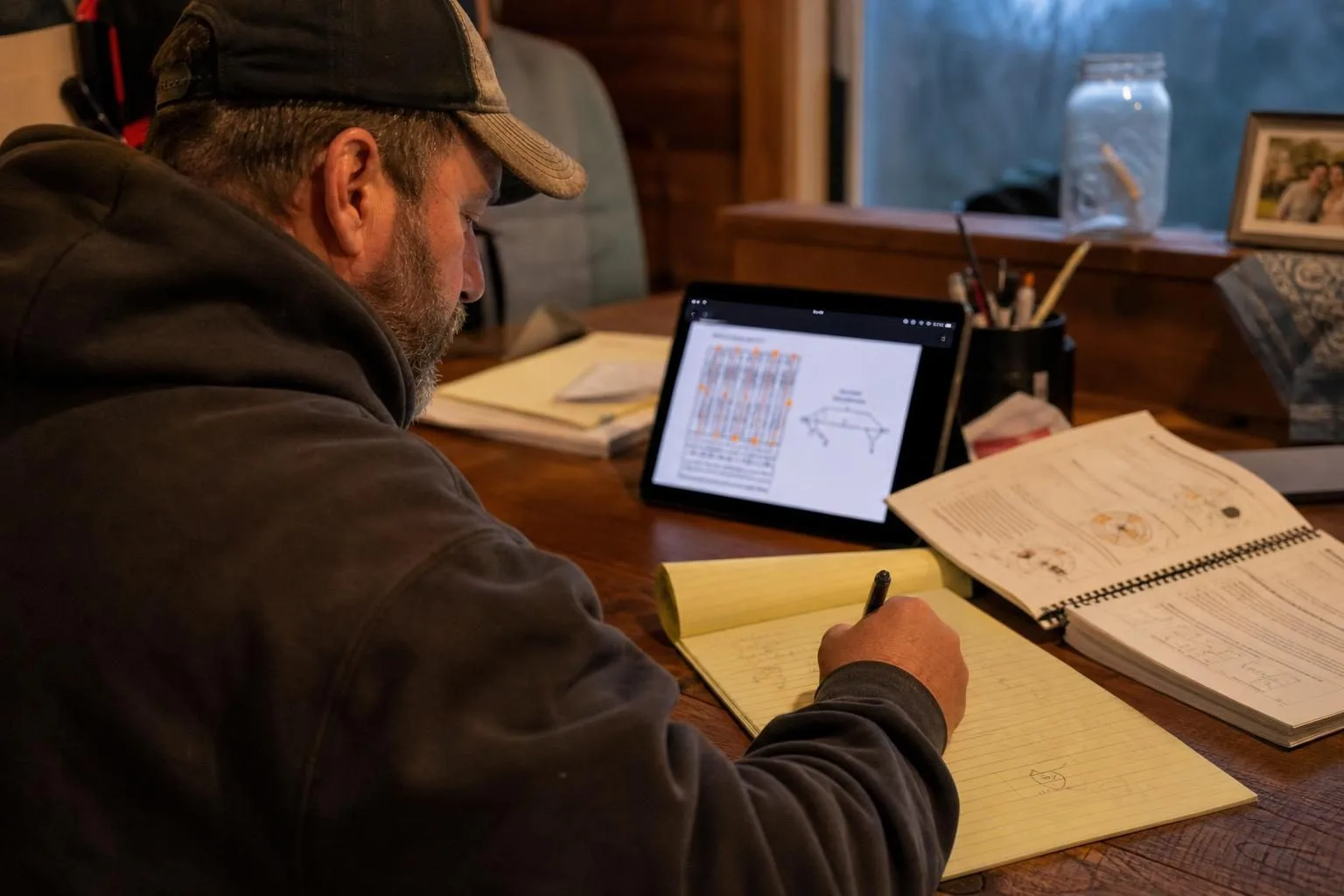
You're studying for your license

You're studying for your license

You get the why behind what you already do with your hands, from burden to the delay plan, one drawing at a time.

Your exam date is close

Your exam date is close

Every formula and every number sits on one page, and the practice book shows you your weak spots before exam day.

You already work on a drill and blast crew

You already work on a drill and blast crew

You get a printable reference for the truck: misfire steps, PPV limits and magazine rules, all drawn and easy to find.

Everything You Get Today

US$ 95.80US$ 27
YES, I WANT BLASTER LICENSE ILLUSTRATED FOR US$ 27

📄 This is a digital PDF book sent to your email: nothing is printed or shipped.

30DAYS
GUARANTEE

30-Day Guarantee

Try Blaster License Illustrated for 30 days, bonus books included.

We refund everything if the file won't open, if the book isn't what you see here, if you were charged twice or if the email doesn't arrive. Just email us.

You pay once. No subscriptions.

Frequently Asked Questions

Is it for me if I already load holes and just need my own license?

Yes. It doesn't waste pages telling you what an explosive is. It draws the reasons behind the work you already do, plus the rules, tables and formulas the exam asks about.

Where does the content come from?

From the official texts. Federal, valid in every state: 27 CFR 555 (ATF), 30 CFR 816/817 and 850 (OSMRE), 30 CFR 56/57 Subpart E (MSHA), 29 CFR 1926 Subpart U (OSHA) and 49 CFR 172, 173 and 177 (DOT). For state rules, the book uses Pennsylvania's 25 Pa. Code Ch. 210 and 211 as its example. Each state runs its own license and exam, so check your state's blaster handbook for what changes.

Is it official material?

No. It's an independent study book. No state agency issues or endorses it, and neither do PA DEP, OSMRE, MSHA, OSHA, ATF or DOT.

Does it replace my blaster training?

No. It doesn't replace the training you're required to take, your state's rules or the manufacturer's and site procedures, and it doesn't give you a certificate or count toward training hours. It helps you understand and review them.

Are the practice questions the ones on the exam?

No. They're written for this book in exam style, to help you find your weak spots. They aren't official questions.

When and how do I get it?

The book and the 2 bonus books come as PDFs by email.

Do I have to pay every month?

No. You pay once.

Can I have it on paper?

Yes. It's a printable PDF, so you can print it and keep it in the truck.

How does the refund work?

You have 30 days. We refund everything if the file won't open, if the book isn't what you see on this page, if you were charged twice or if the email doesn't arrive: just email us.

Before You Close This Page

No more rereading the rules and having nothing stick.

You see the bench drawn, from burden to subdrill, and it clicks.

You walk into the exam knowing where everything is.

Drawings make studying faster.

The book is right below.

One-time payment: US$ 27 · Guarantee: 30 days · PDF by email

YES, I WANT BLASTER LICENSE ILLUSTRATED FOR US$ 27

📄 This is a digital PDF book sent to your email: nothing is printed or shipped.